

Reconsidering Justice (Global Focus on Knowledge)






11

7

3
Content List
正義を問い直す


Audio-Only
Listening
#1 Introduction
Audio-Only
Listening

Available
Audio-Only
Listening
#2 Moral Dilemmas and Utilitarianism
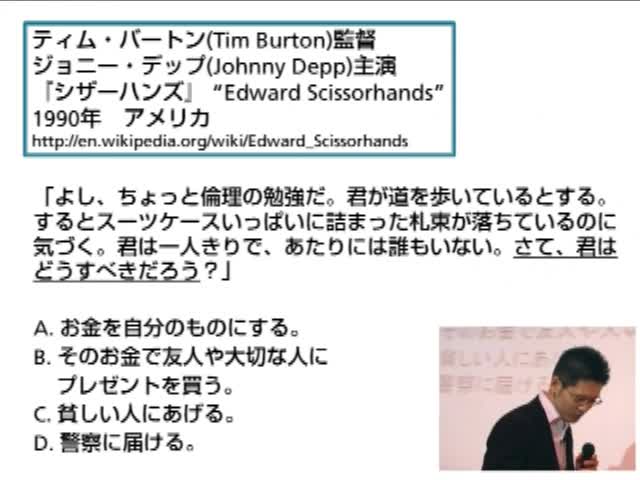
The fields of ethics (moral philosophy) and political philosophy often address moral dilemmas, as in cases such as the problem of the runaway trolley. Such exercises are not (just) a form of play, but are employed as “thought experiments” to test our intuitive thinking and ethics. In this lecture, we will use materials related to several moral dilemmas involving such situations as the trolley pro…
Available
Audio-Only
Listening
Available
#3 Aristotle: Happiness and Virtue
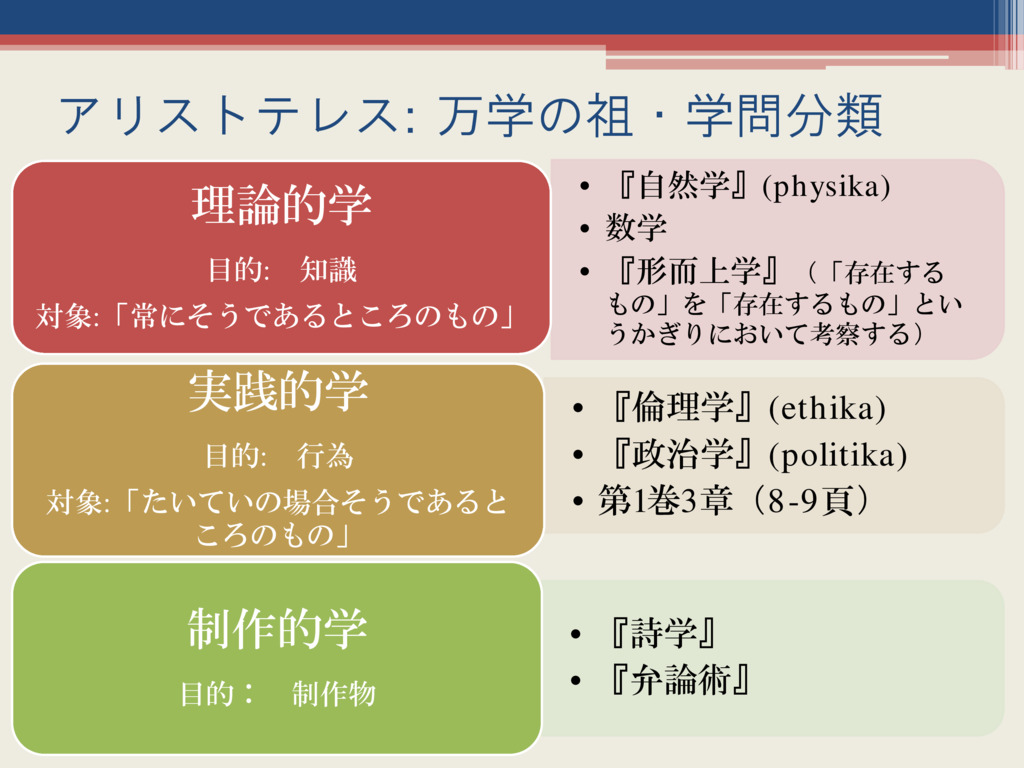
In contrast to the ethics of obligation which forms the mainstream in modern times, ethics during ancient and medieval times frequently was notable for its emphasis on the ethics of happiness. The first systematization of the ethics of happiness was the detailed analysis contained in the opening section of the Nicomachean Ethics of Aristotle, and we will use it to shed light on the basic distingu…
Available
Available
Audio-Only
Listening
#4 Kant’s Theory of Justice
We will discuss the theory of justice expounded by Immanuel Kant, concentrating on discussion of Sandel’s interpretation of Kant’s Groundwork of the Metaphysics of Morals, while seeking to delineate what are the principles inclining towards pleasure, etc. and the opposing principles of moralistic self-restraint. Actually, in terms of a theory of justice, since we need to take into account areas w…
Available
Audio-Only
Listening
Available
Audio-Only
Listening
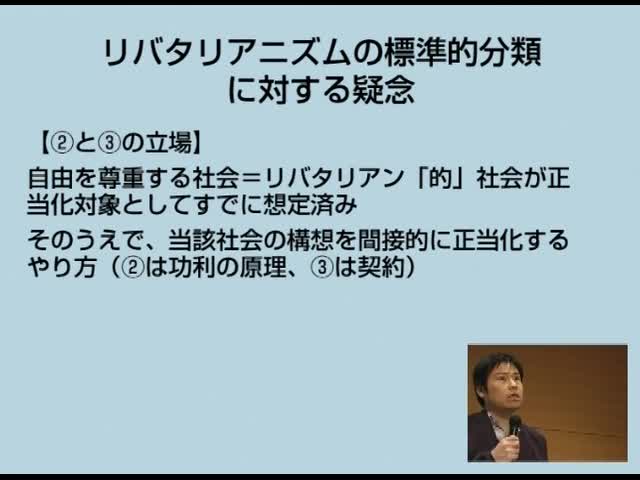
#5 Libertarianism as a Theory of Justice: From Locke to Nozick
Within libertarianism we will concentrate our study on the theory of entitlement proposed by Robert Nozick, especially focusing on how Locke’s theory of property has been assimilated and invoked by Nozick’s entitlement theory, and will discuss the possibilities for libertarianism as a theory of justice and related problems. (Chapters 3 + 4)
Available
Audio-Only
Listening
Available
Audio-Only
Listening
#6 Distributive Justice and Its Critics: Rawls vs. Nozick
We will identify the essence of John Rawles’ A Theory of Justice (1971), which belied Isaiah Berlin’s famous comment that “political theory died in the 20th century”, and, after examining Nozick’s entitlement-based criticisms of Rawles position, discuss the possibilities for Rawles’ theory of justice and problems with that theory. (Chapters 7 + 8)
Available
Audio-Only
Listening
Available
Audio-Only
Listening
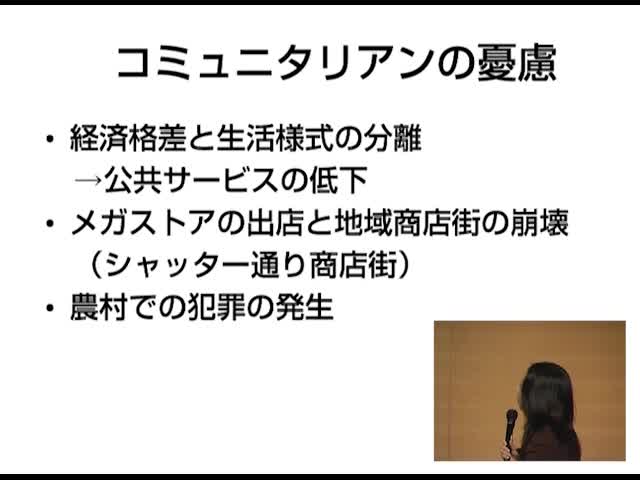
#7 The Market and Ethics, Communitarianism
Are there cases in which free transactions in markets need to be regulated to ensure fairness? This lecture will focus on communitarianism and communitarian criticisms of markets. (Chapters 5+12)
Available
Audio-Only
Listening
Available
Audio-Only
Listening
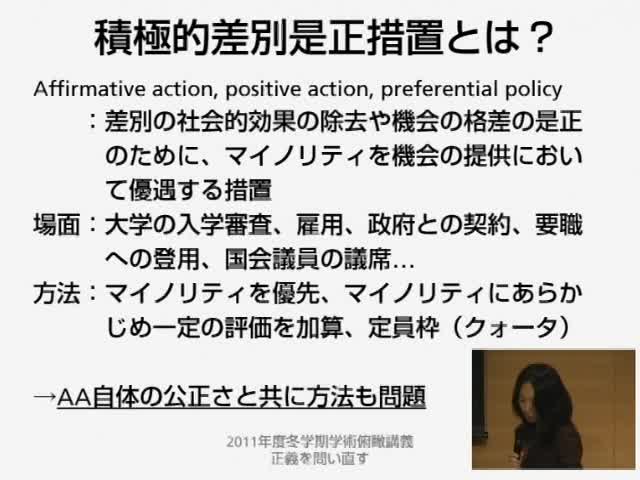
#8 Disabilities and Discrimination, Proactive Measures for Remedying Discrimination
In guaranteeing equality, should the disabled and minority groups in society enjoy more favorable treatment than healthy individuals and majority groups in society? This lecture will consider the nature of equality. (Chapters 9 + 11)
Available
Audio-Only
Listening
Available
Audio-Only
Listening
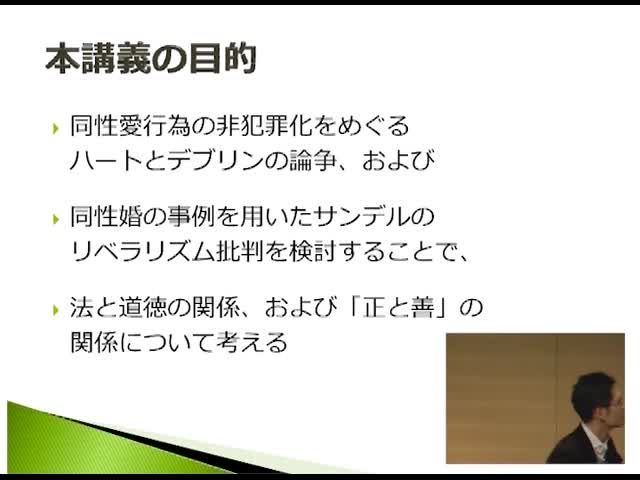
#9 The Law and Morality: Subject Matter related to Homosexuality
A classic question for legal philosophy has been, “Should the law make morality compulsory?” The model reply from liberalism has been: “For example, even though a certain behavior might be considered immoral, as long as it does not harm others, it should be allowed to be freely engaged in.” This lecture will consider the debate between H.L.A. Hart and Lord Patrick Devlin on whether homosexual act…
Available
Audio-Only
Listening
Available
Audio-Only
Listening
#10 Just War Theory
Fifty years after the end of the Second World War, the National Air and Space Museum of the Smithsonian Institution in the U.S. capital of Washington D.C. planned to hold a “Postwar 50-Year Anniversary Exhibition.” The arguments back and forth concerning the original plan for the exhibition became the trigger for heated discussion in various mass media outlets within the United States concerning …
Available
Audio-Only
Listening
Available
Audio-Only
Listening
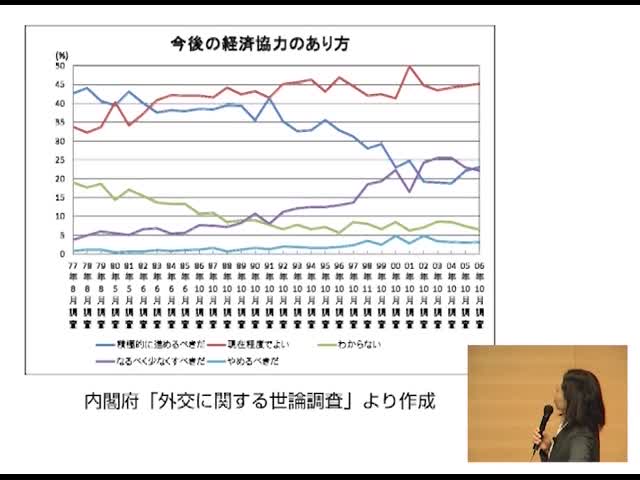
#12 Global Distributive Justice
Since in Japan too there are issues of economic inequality and poverty, why should the Japanese people have to provide assistance to various countries situated on the other side of the globe? This lecture will deal with viewpoints concerning global distributive justice.
Available
Audio-Only
Listening
Available
Audio-Only
Listening
#13 Political Liberalism in Late-Period Rawls
In his late period, Rawls shifted from the philosophical theory of justice of his early period to a “political liberalism” stance that depends upon “overlapping consensus” as a neutral benchmark amidst polemical philosophical theories. We will examine together the problematical elements inherent in Rawls’ position, Sandel’s critique of it, as well as Inoue’s criticisms of both of them. (Chapter 1…
Available
Audio-Only
Listening
 Back to Series List