Series
AY 2013
Robustness and Plasticity of Life (Global Focus on Knowledge)

Coordinator: Tetsuya Tabata (Institute of Molecular and Cellular Biosciences),
Noboru Mizushima (School of Medicine)
Navigator: Miho Ohsugi (College of Arts and Sciences)
The creation of induced pluripotent stem cells, or iPS cells, which make it theoretically possible to generate individuals from single cells, is a great discovery. This reminds us of the dual nature of life. One is the robustness of life in passing on all of its information to following generations through genome. The other is the plasticity of life that allows its information to create a wide variety of cells. This dual nature – robustness and plasticity – is the reason why the chain of life has continued ceaselessly over the past 4 billion years.
This course of lectures will discuss the biological activities that comprise the apparent contradiction of life’s dual nature of robustness and plasticity. Such discussions will be made through analyzing ontogeny, intracellular protein replacement, the potential of iPS cell-based regenerative medicine, biological clocks, and the activity of cranial nerves. We will analyze these issues, putting emphasis on information control covering genome to biological activities.
Content List
Life’s robust shape formation
1:08
Resources
Available
Available
Available for
Audio-Only
Listening
Audio-Only
Listening
#1 Segmentation clock to accurately regulate rhythmic pattern formation
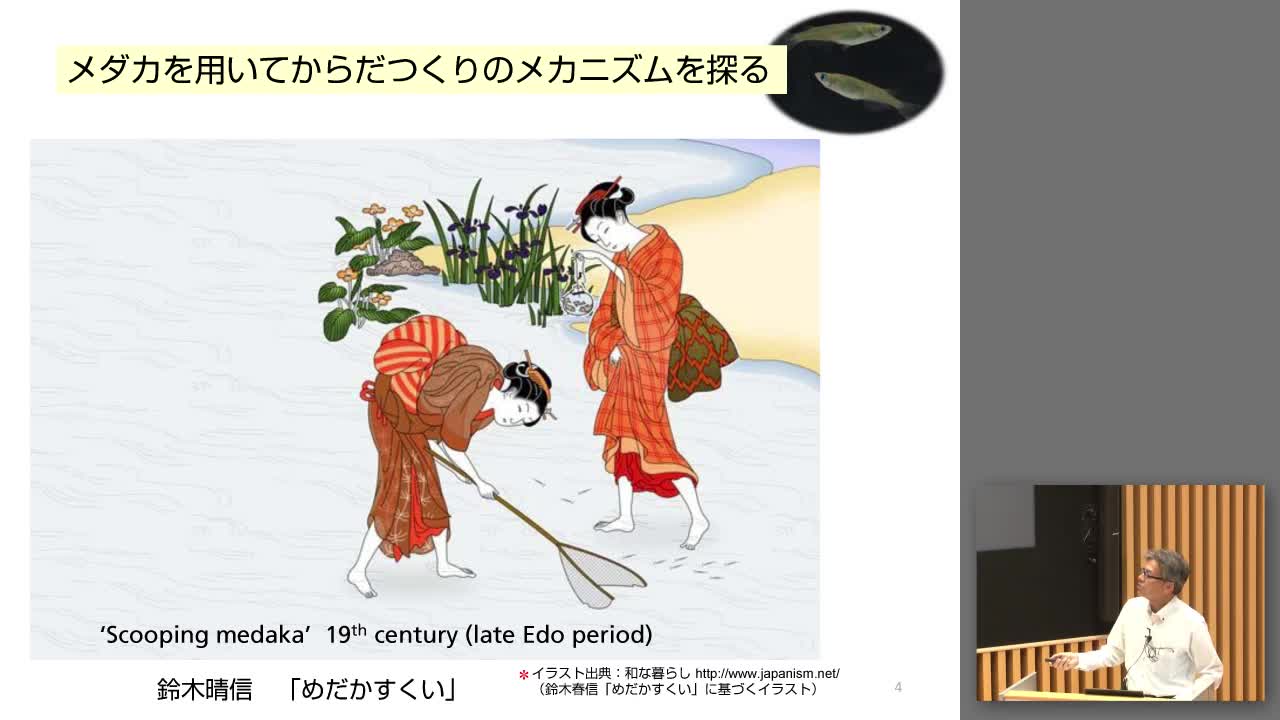
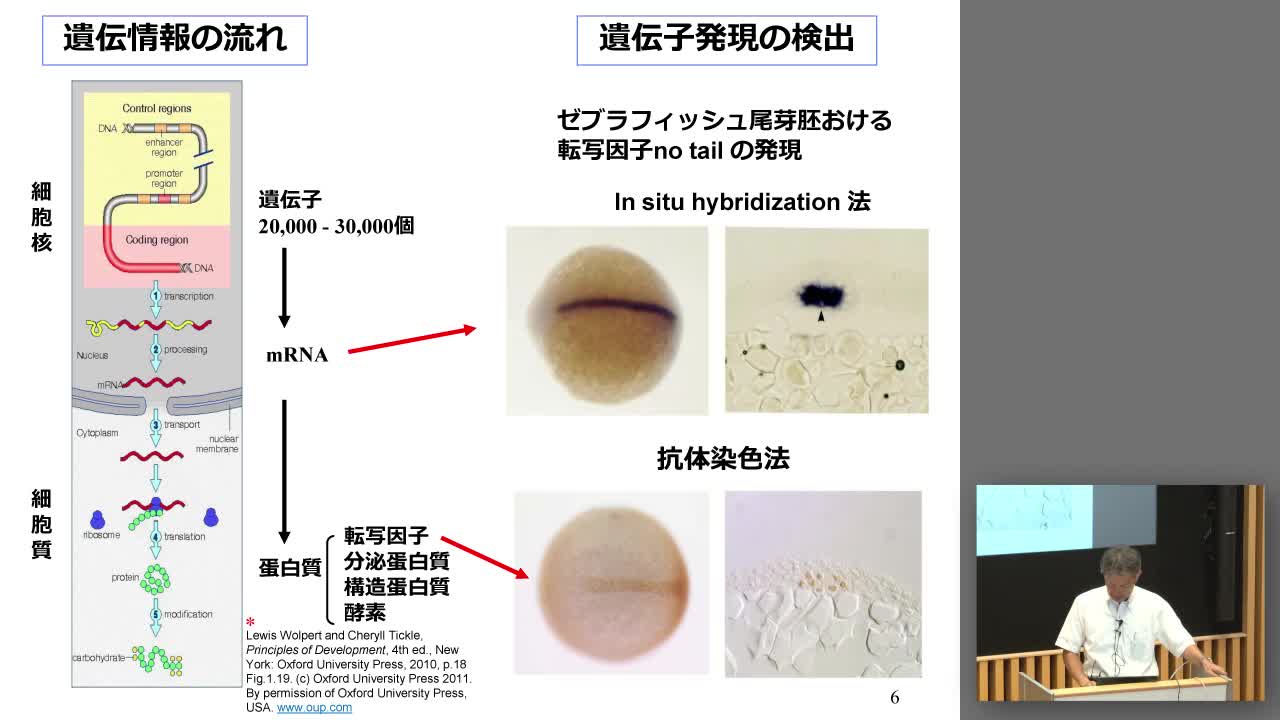
Overview: Multicellular organisms have their own specific shapes that widely vary. These shapes emerge from single fertilized eggs. We will discuss the underlying developmental principles by using zebrafish and Japanese killifish as models, focusing on the noise-resistance and modularity in pattern formation.
Lecturer | Hiroyuki Takeda
1:08
Resources
Available
Available
Available for
Audio-Only
Listening
Audio-Only
Listening
1:20
Resources
Available
Available
Available for
Audio-Only
Listening
Audio-Only
Listening
#2 Modularity of development to create a variety of shapes
Overview: Multicellular organisms have their own specific shapes that widely vary. These shapes emerge from single fertilized eggs. We will discuss the underlying developmental principles by using zebrafish and Japanese killifish as models, focusing on the noise-resistance and modularity in pattern formation.
Lecturer | Hiroyuki Takeda
1:20
Resources
Available
Available
Available for
Audio-Only
Listening
Audio-Only
Listening