

UTokyo Open Lectures: Bones





1

2

2
Content List
Bones to support a long life

#1 Opening lecture remarks
In this extension course, starting with the bones of human beings and other animals, we will discuss with experts from diverse fields about the roles of “bones” and their mysterious workings in various solid bodies and structures, as well as the skeletal structure of the universe.

Available
#2 How to build a body that won’t show its age—Preventing osteoporosis
This lecture will study the make-up of bones, the role of bones and the process by which bones age, and then we will closely examine widely-accepted but mistaken “commonly accepted knowledge” about bone health. Using these topics as a basis, we will study in detail what people can do to build stronger bones.
Available
Available
#3 Pains in the joints, pains in the bones
According to a survey by the Ministry of Health, Labor and Welfare, the most frequent self-diagnosed health complaints for both men and women are lower back or hip pains, stiff shoulders and joint pains. These symptoms often occur due to osteoarthritis and osteoporosis. In this lecture, we will offer an overview of the mechanisms of and countermeasures for these aches and pains.
Available
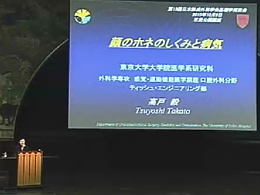
#4 Structure and maladies of facial bones
The embryology of facial bones is different from those of the hands and feet in that their forms are highly complex and truly finely formed. In this lecture we will consider the vital functions of these facial bones.
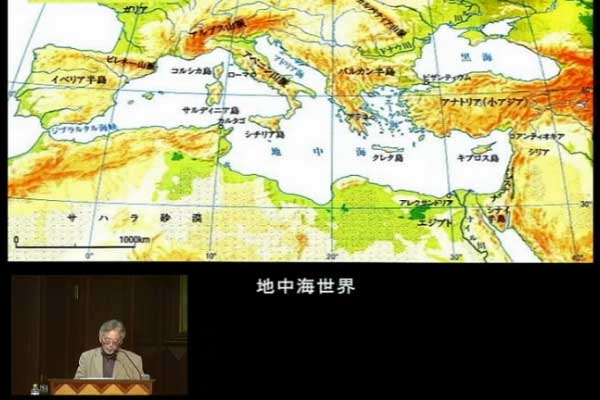
“Bones” in the human soul
Available
#6 Embracing bones—The burial system and human remains in Madagascar
In this lecture we will explore the social meanings and methods of human interaction in the burial system of Madagascar, an island situated in the extreme western part of the Indian Ocean, so as to understand the way of looking at life and death, and the significance of bones in this society.
Available
Available
#7 How did people during prehistoric times handle bones?—Reburials and ancestor worship
During the Yayoi Period in Japan, the remains of the dead which had been buried were often reburied, and “re-internment” became quite popular. This lecture compares burial practices in prehistoric societies throughout the world, and verifies the results.
Available
Available
#8 ”Bones” (solidly reliable element) in the soul to provide support when unemployment is experienced
While unemployment is a macro-societal problem, it is also an experience which causes much economic, social and psychological stress for individuals. What can they do to make the lives of such unfortunates seem worth living once again? By focusing on unemployment, in this lecture we will reexamine issues related to work and living.
Available
The rigidity and elasticity of “bones”
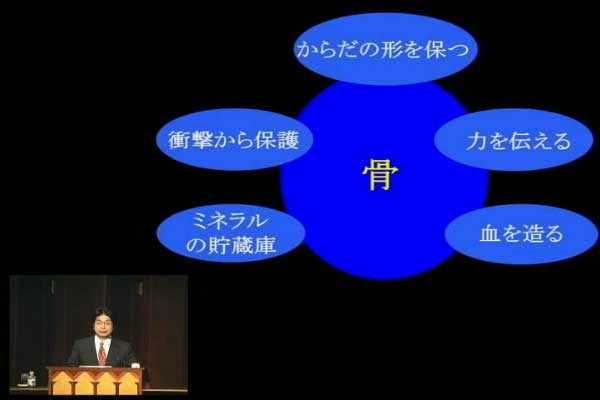
#9 Structure and maladies of facial bones
The embryology of facial bones is different from those of the hands and feet in that their forms are highly complex and truly finely formed. In this lecture we will consider the vital functions of these facial bones.
Available
#10 The mechanisms shellfish and pearls use to create their “skeletons”
Invertebrates possess hard shells and this is what determines their body shape. Shellfish as elastic animals have shells in order to protect their molluscous soft bodies from predators. In this lecture we will consider the mechanism for the formation of these skeletal structures.
Available
“Bones, ” the supporting structure for countless creatures
Available
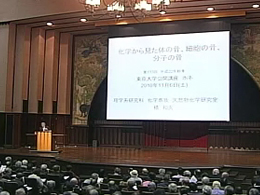
#11 A look at the bones in the body, the “bones” in cells and the “bones” in molecules from the perspective of chemistry
This lecture will introduce the equivalents of “bones” present at levels corresponding to various epochs, going back to periods before when calcium was available to living organisms.
Available
Available
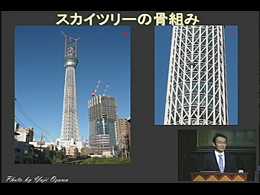
#12 Tensegrity— The “skeleton” that ties together cells and architecture
Although for many years the principle of “tensegrity” (tensional integrity or floating compression) could not be applied to architectural frameworks, in recent years a theory appeared which calls for the creation of skeletal forms like those in the cell membranes of living organisms. In this lecture we will consider from the perspective of architectural structures the principles related to skelet…
Available
#13 Closing lecture remarks
Along with remarks marking the finish of this series of lectures, we would like to consider our “modern age” through the lens of “bones.”
 Back to Series List