

UTokyo Open Lectures: Power





2

0

0
Content List
The principles of power— Life, nature and human society

#1 Opening lecture remarks
What does the “power” in the expression ”knowledge is power” really mean? In this course, we will try to explain how “power” is at work in all areas, including nature, society and culture, surveying many disciplines from both the humanities and the sciences.

Available
#2 Analogies between structural dynamics and political dynamics
The concept of “power” is not solely limited to physical strength, but is also used to compare various things. Moreover, among them there are commonalities in the way that this concept is expressed, while systemic commonalities arising from the same also exist. In this lecture, we will make comparisons between physical phenomena for structural elements and materials and political phenomena.
Available
Available
#3 Molecular level weak force, which holds the key to life and nanotechnology
In this lecture, we will discuss how the weak force that operates between molecules is skillfully employed in the creation of things. Our research will look at how by tapping into the latent strength of the “self-organization” capability lurking within molecules, each individual molecule can functionalize its order.
Available
Where does strength in the body come from?—From the heart to the muscles
#4 New strategies for muscle adaptive mechanisms and building muscle (strength training)
The strength generated by the skeletal muscles ( = muscle power) is what speeds up or slows down the body or parts of it, and generates body movement. Body movement includes nearly all normal motions and muscle power is thus an indispensible ingredient for the maintenance of life. This course will focus on discussion of this physical strength.
Available
#5 Strength exhibited by redundant musculoskeletal systems
In this lecture, considering that muscle activity is determined in a simple albeit counterintuitive form, we will explain what kinds of mechanisms cause such activity and what kinds of meanings it holds. Incorporating these concepts should facilitate more finely-tuned muscular strength training as well as offer rational explanations for the odd behavior of muscle activity.
Available
Design/ information collection/ negotiating – Techniques for utilizing power
Available
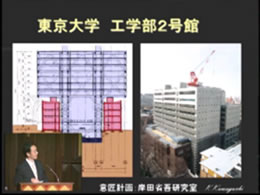
#6 Strength and architectural designs
Architecture involves satisfying requirements for several elements. In order to satisfy one of them, namely safety, it is necessary to consider various forms of “strength.” The results are visibly manifest in the architecture itself. In this course we will discuss the ways in which various forms of strength are applied in terms of influencing architectural design.
Available
#7 Negotiating power—“Power” and the law in transactional and dispute resolution
What does the expression “negotiating power” actually mean? Is it something which can be studied and acquired, or simply a God-given talent? Moreover, how does the law operate within negotiations? We will consider together the various ways in which “power” manifests itself in actual daily life in terms of the negotiations we engage in to form relationships with other people and other companies.
Cutting edge theories concerning power–Yukawa Hideki Centenary
Available
#8 100 years of nuclear power
This lecture will discuss the Yukawa Theory concerning nuclear forces, touching upon the contributions of the theory, surveying the development of state-of-the-art research concerning “nuclear power, ” shed light on the modern image of “nuclear power, ” and talk about how fascinating and rich this subject can be.
Available
Available
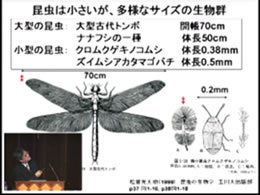
#9 Life force exhibited by insects– The power to respond to the environment
It is difficult to define the concept of “life force, ” since the meaning changes according to the perspective adopted. Nevertheless, if viewed from the perspective of evolution, the lecturer believes that the basic characteristic of life has its power to respond to (changes in) the environment. In this course, from that perspective, we will discuss the life force displayed by insects.
Available
Visible war, invisible power –International society and Japan
#10 Contemporary Japan and military power— Learning from history
By concentrating on the period from World War I until the outbreak of the Manchurian Incident, we will discuss how memory of the combat command (Kriegsführung) during the Russo-Japanese war underwent change in the ranks of Japan’s military. We will also discuss how the content of “special privileges” for Manchurians and Mongolians ballooned under diplomatic leaders.
Available
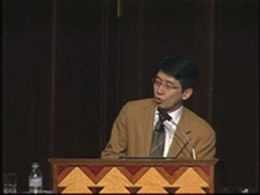
#11 An America that no longer manufactures; a Japan incapable of marketing: In search of customer power
Since in mature economic societies tertiary (service) industries are the mainstay, not only secondary industry in the form of manufacturing, but rather skillful use of the synergy between the “hard” and the “soft” will be the path that Japan needs to follow. Fields related to marketing therefore need to be included among the sinews of “creating things.”
Available
Available
#12 Americanism and power in postwar Japan
While on the one hand in the present era “America” is a world power enjoying overwhelming superiority, it also has assumed an existence that permeates our daily lives here in Japan. In this lecture, we will examine the dual faces of “American” power in postwar Japan and search for the deep-seated dynamics of the pro-American consciousness among the Japanese people.
Available
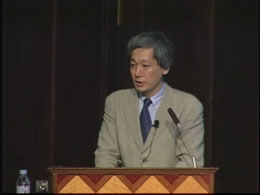
#13 Authority, power and violence in international politics
The same word “power” conjures up very different images in terms of domestic society and international relations. In this lecture, we will analyze the three components of “strength” (namely authority, power [influence] and violence) and study how “power” operates in international politics.
 Back to Series List