

UTokyo Open Lectures: Maturity






1

1

1
Content List
Maturity and human beings in modern society


Available
#1 Opening lecture remarks
What is maturity and what does it make possible? And why is it difficult to attain? This lecture series will from the standpoints of these issues seek to think about changes in the forms taken by humanity and society, culture and nature.
Available
Available
#2 Composition of maturity
This lecture will discuss what exactly maturation is and why it is so difficult, and will talk about what conditions are indispensible for the maturation of human beings and society, and what things become possible if maturation is achieved.
Available
Available
#3 Changes in the welfare state and “maturation”: Societies in which it is difficult to become an adult and education
In this lecture, we will attempt to unravel the paradox that schools, which are supposed to have been established in order to teach children during the period in which they are preparing to become adults, have changed into places where it becomes difficult to actually produce adults.
Available
Available
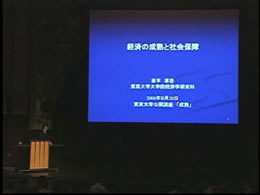
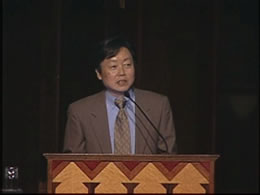
#4 Economic maturity and social security
The single greatest economic problem facing a society that is aging and seeing fewer children born involves fiscal management of social security programs. The basic structure of the fiscal problems facing social security can be summed up as: “a social security financial system deteriorates as the ratio of the elderly population to the entire working population rises.”
Available
Diverse aspects of maturity
Available
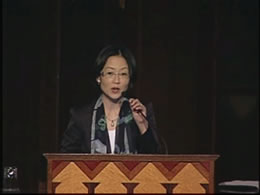
#5 Animal maturation and behavior
In addition to discussing the maturation of animals, from the standpoint of physical and emotional health, there is a need for us to consider maturation not only in terms of physical maturation but also emotional maturity. After all, doesn’t understanding the animals around us help deepen our understanding of ourselves as human beings?
Available
Available
#6 Democracy and maturation/ Media society
In this lecture we will be investigating new democratic theories for the sake of a society, which were born and matured through critical study of modern democratic theory, as well as analysis of conditions in the media society during the Internet age. In addition, we will want to consider points of contact between matured democratic theories and the media/Internet society, and the order prevailin…
Available
Maturing into adults
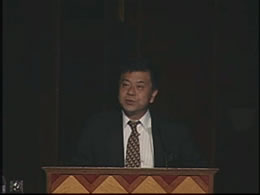
#7 The development and growth of the individual—The transformation processes from infancy to adulthood
As individuals, we have a certain amount of knowledge about our own appearance, talents and capabilities. But how exactly did we acquire such recognition concerning the self? In this lecture we will consider issues surrounding individual cognition.
Available
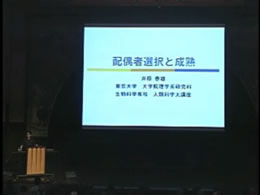
#8 Choosing a spouse and maturity
This lecture will discuss a broad range of topics ranging from sexual selection related to the choice of a mate, the evolution of preferences, MHC and mate selections among mice, studies of preferences, and the choice of mates among human beings.
Available
The maturation of culture
#10 Kabuki—The formation of the onnagata tradition
This lecture will discuss the maturation within the kabuki theater of the onnagata tradition of males playing female roles, including the establishment of the basic techniques employed by the onnagata and the myth of young onnagata never growing old.
Available
#11 Blockage (heisoku) and maturity—Poetry and fiction in Ming Dynasty China
This lecture will be a historical discussion concerning poetry and fiction during Ming Dynasty China. We will look at the process by which Chinese literature evolved from an inward-looking period to a mature literary period, spreading to the masses, and achieving maturity in fiction written in the baihua vernacular.
Available
Available
#12 Community-building in a mature society
In this lecture, we will discuss changes in thinking concerning community-building, the special characteristics of community-building in a mature society, as well as thinking concerning what we will be looking for in future mature societies.
Available
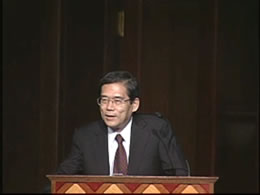
#13 Closing lecture remarks
Thank you for attending The University of Tokyo’s open course on the theme of “Maturity” over the past five weeks. Finally, to conclude this course, university Vice-President Junichi Hamada (at that time) will offer remarks.
 Back to Series List