

UTokyo Open Lectures: New Century for Robots






0

0

1
Content List
The future course for robots


Available
#1 The History of Robots
We will introduce the history and philosophy, realized forms and technologies of robots from three standpoints: robots which aim to embody the intelligence functions of human beings and the movement capabilities of human beings, robots which aim to surpass human beings in terms of the working capabilities of human beings, and robots which live side-by-side with human beings in daily activities.
Available
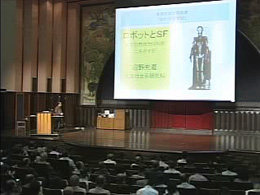
#2 Robots and Sci-fi
In this lecture, while introducing works by Stanislaw Lem and Isaac Asimov, we will investigate the links between literary imagination and science and technology.
#3 Self-distribution Robotic Systems
If intelligent robots are gathered together, production systems which can readily adjust to changes in production volume and procedures can be realized. This lecture will discuss the history and present state of self-differentiation (self-distribution) robots, and shed light on what “swarm” (intelligence) robots actually are.
Robots and society
#4 What Do Robots Mean for Human Beings?
Why do human beings find things which resemble themselves to be creepy? Can a society in which human beings and robots coexist together really come about as long as such sensibilities exist? While referencing actual past examples and literary works, we will consider the relationship between robots and human society.
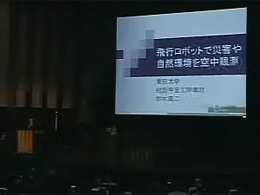
#5 Drones for Observing from Midair
Research and development is currently proceeding for flying robots (drones) capable of in-flight photographing on an emergency basis when disasters occur. There are high expectations for the use of such flying robots during normal times as well for such uses as monitoring the natural environment and traffic congestion. In this lecture, we will discuss issues and problems related to when flying ro…
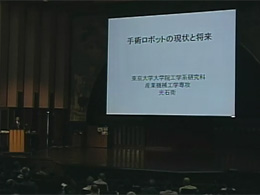
#6 Present and Future of Surgical Robots
Highly sophisticated medical care technologies will be required in an aging society with fewer children being born. Surgery conducted by robots can help to alleviate the burdens on patients and doctors, rectify the imbalances in medical care among different localities, beef up first aid medical care, and elevate the level of medical education. In this lecture we will give an overview of the prese…
Robots and knowledge
#7 How Do Babies Recognize Robots?
There are indications that from a very early stage human infants are capable of distinguishing between “human beings” and other things. In this lecture, based on research related to artificial object recognition among infants, we will discuss the prospects for robots which have their own existence in the interval between “things” and “people.”
Available
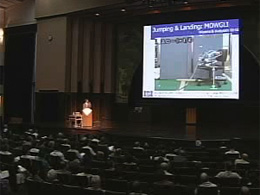
#8 Robots Approaching to Mankind
Through robot fabrication and experimentation, cutting-edge robotics research in the area of intelligence development is currently being carried out with the goals of achieving a better understanding of human beings and the realization of new robotic intelligence. This research is shedding light on the intimate interplay between human-like bodies and human emotions and behavior.
Available
Available
#9 Robots and Dynamic Growth of Human Brain and Body
Dynamic reciprocal interactions among the brain, body and the environment have attracted attention, and in this lecture we will introduce aspects which transcend various academic disciplines, including neuroscience (brain science), developmental psychology, complexity theory, as well as the cutting edge of research currently taking place in this sector. Actually, these kinds of questions are deep…
Available
#10 Robotic Right Brain Baced on Semiconductor Technologies
“Right brain computers” are like human beings capable of “flexibly judging and understanding situations through associative thinking and intuition.” How could they ever become capable of performing such feats? We will explain in easy-to-understand fashion starting with the basic principles of semiconductor electronics.
Robot anatomy
Available
#11 Human Bodies and Robotic Bodies
Robots might be characterized as “computers with bodies.” How do these bodies attain their “form?” What kind of intelligence do robots which will operate in proximity to human beings in daily life activities require? We will address these kinds of questions in our lecture.
Available
#12 Humanoid Robots
Robots which have been made to have a human appearance are referred to as “humanoid robots.” Based on examples from research being carried out at the University of Tokyo, we would like to discuss the situation for humanoid robots up to this point as well as the outlook for their use in the future.
#13 The World of Ultra-fast Robots with Vision Chips
Against the background of the development of semiconductor integration technologies, vision chips which combine photography functions with arithmetic processing functions integrated into a single chip have been developed. We will explain the principles and construction of vision chips, and introduce various actual examples of high-speed robots in a video.
Available
#14 Computer-integrated Surgery Support Systems
In this lecture we will introduce the R&D trends concerning computer-integrated surgery support systems which apply robot technologies.
Available
Robot futurology
Available
#15 Robots as Interfaces
We are entering an age of full-scale informatization, as the importance of technologies which seamlessly connect cyber-space with real-space grows, and the expectations for robots grow apace. This lecture will explain the new image of robots that is emerging.
Available
Available
#16 Robots and Art
In recent years, experiments in the fusion of the arts and engineering have been rife in the field of media arts. In this lecture, through explanation of robots which have been developed for the sake of artistic expression, we will investigate the direction being taken to bring about the materialization of “robots with soul.”
Available
Available
#17 Autonomous Robots for Diving into Ocean Depths
Just as there are many varieties of life in the ocean, there are bound to be many types of robots active in the sea. There is a desire to use free thinking to produce innovative robots, so as to create a “robot kingdom” within the world’s oceans.
Available
#18 Robots for Agriculture and Forestry Industries
This lecture will introduce the history of the mechanization of agriculture, and explain the effects of this mechanization. Next, we will introduce examples of robots now being developed for agricultural use. Finally, we will discuss the goals and methods used in intensive agriculture, as well as future prospects for “robot agriculture.”
Available
#19 New Century for Robots
In this lecture we will address the subject of IRT technologies, which represent a fusion of information technologies (IT) involving cyber-world technologies and robot technologies (RT) for the real world. The resulting IRT innovation creations promise to effect a revolution in society through such things as robots of the future which could be used around the house.
Available
 Back to Series List