

UTokyo Open Lectures: Balance






0

2

0
Content List
Emotional balance

#1 Opening lecture remarks
Throughout society, we have seen erosion of the feeling that “extreme simplicity is balance, ” which in turn has led to various problems. This lecture will seek to zero in on the basic characteristics of balance from various angles, including contemplation on exactly what balance consists of and the vitality that arises from the loss of balance.

Available
#2 Balance between emotional responses and non-responses
Since psychological conditions which involve depression and anxiety display both responsive and non-responsive aspects, it is vital to achieve a balance. “Cognitive-behavioral therapy” is a form of psychological therapy which, while attempting to control the psychological ailment, adopts a position close to one saying that achieving coexistence is the desired outcome.
Available
Available
#3 Balance for children, balance for the family
If adults do not respond skillfully to emotional problems of children, in many cases we see instances in which the children develop clinical problems. What is a viable balance for children and families? What can be done to induce positive changes? In this lecture, we will address such questions.
Available
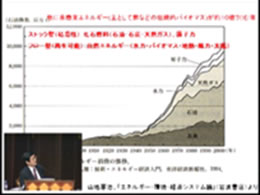
How can balance be achieved among diverse standards of value?
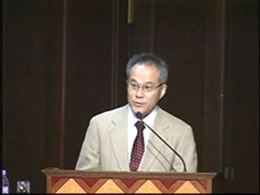
#5 Balance in legal thinking
The law often realizes the futility of using a single benchmark to compare things, and therefore weighs a balance of various values, interests, reasons, etc. to come up with results. In this lecture, we will introduce the preliminary arrangements used by the law in such a case, as well as the background to the use of these preliminaries.
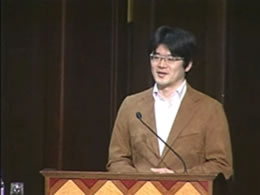
#6 Thinking about “work-life balance”
By committing to a work-life balance, Japan could probably find the key to solving the severe and diverse labor problems it faces today, including how to make effective use of women, the problem of fewer children being born, etc. Through comparisons with Western countries, we will consider the roots of Japan’s labor problems.
Available
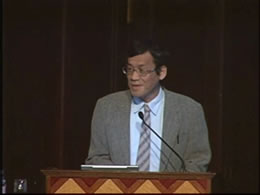
#7 Efficiency and fairness— Balance in reform of the tax system
Efficiency and fairness are basic concepts used as standards to evaluate economic policies. However, for Japan, where globalization and aging are proceeding apace, the actual results are not always in line with these standards. Taking the example of the recent reform of the tax system, we will consider the kind of balance that would be needed as well as what would be feasible.
Available
Ecological balance and species variation
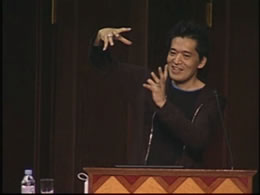
#8 Balance and evolution creating chaos
Chaos is demonstrated in classic cases of instability and unpredictability, but the fact is that chaos itself can aid in the establishment of constancy (homeostasis = balance) among life forms. Moreover, homeostasis is the source not just of the “preservation in fixed form of a single thing, ” but also of diversity. In this lecture, we will consider chaos and balance, which at first sight seem in…
Available
#9 Achieving balance for rice plants and rice (output) in crop cultivation
In the cultivation of crops, it is difficult to achieve a balance among four desired factors. These are: (1) high yield, (2) quality, (3) low burdens/low costs for the cultivator, and (4) environmental friendliness/safety. Using the example of rice cultivation, we will discuss the processes required for establishing these, historical changes and current approaches to achieving balance.
Available
Available
#10 Fluctuations in marine resources and balanced fish substitution
Due to long-term changes in climate and the oceans, various marine resources in the oceans of the world have witnessed conspicuous change along with shifts in the fish species present. Therefore, if we are seeking balance in marine resource production, we must look not to single-species use, but rather intelligent use of marine resources which integrates multiple species.
Available
Things existing within a visual balance
Available
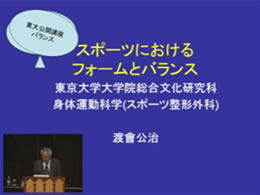
#11 Form and balance in sports
In order to prevent injuries, we study sports medicine and undertake well-balanced training. While offering examples from medical checkups and actual ailments, etc., we will discuss what should be considered good physique and form as seen from the standpoint of sports medicine.
Available
#12 The aesthetics of (un)balance
Balance is established through a process of harmonization. Something which at first sight might look like it is unbalanced still has as its basis constituent elements of a balance. We will consider how this state of affairs is addressed in several aesthetic theories and finds tangible expression in artistic phenomena.
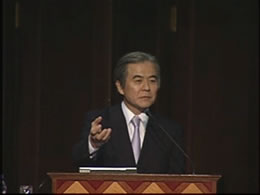
#13 Closing lecture remarks
Finally, Hiroshi Komiyama, president of the University of Tokyo (at that time), will speak on the topic “How to achieve balance between ‘our planet’ and ‘Japan’s national interests.’”
 Back to Series List